
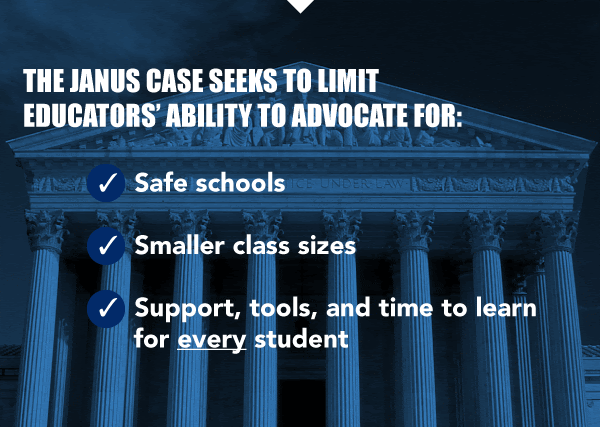
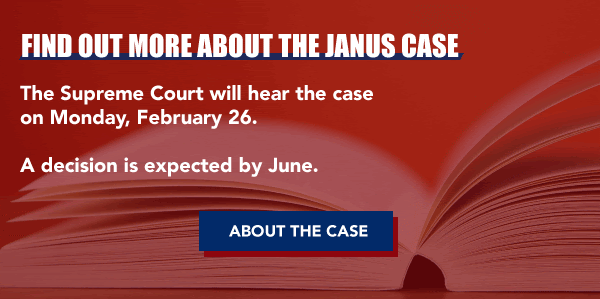
 This summer, the U.S. Supreme Court plans to take up Janus vs. AFSCME. This case will likely dramatically impact the way public sector unions, including the IEA, operate. The Supreme Court’s decision could result in a change in the law and may mean public sector unions can no longer collect fair share dues. Regardless of what the Justices decide, the Janus case is an opportunity to help us grow and build a stronger IEA. The decision gives us the opportunity to build and refocus on how we were born, the kind of powerful, grass roots advocacy the IEA was founded on that helped pave the way for significant legislative and legal victories. History proves we are stronger united. It means we can and will create a more powerful membership and a more powerful organization. We will continue to represent school employees and provide them with the strong voice they need to support good schools and a quality education for all students in Illinois. We will continue to move forward. We are 135,000 strong and have a powerful voice that cannot be ignored when we stand united.
Unions have played a critical role in building and protecting the middle class in America. We provide hard-working people economic stability for their families and give them the tools to build a good life, home and education for themselves and their children. Unions raise wages for both union and nonunion workers. They advocate for policies that benefit all working people such as increases to the minimum wage, affordable health care and great public schools.
Through collective bargaining, members of strong unions are scoring victories that help entire communities.
The IEA was organized by superintendents, principals, teachers and other friends of education in 1853 and was originally known as the Illinois State Teachers’ Institute. In 1936, our name was officially changed to the Illinois Education Association to better reflect our evolving mission. In the more than 150 years we’ve been in operation, the IEA has achieved innumerable wins for both public education and our students. Learn more about how education wins with the IEA.
Corporate wealth is fueling these attacks because they want to eliminate unions, maximize their profits at the expense of their employees, and take away the collective voice of the working and middle class. The Janus case isn’t about what’s good for us or our students. It’s about making it harder for working people to get ahead, making it harder for us to stand united and fight for our students, our schools, our paychecks and our benefits. As members of a union, you should know you will likely be getting mailers, seeing billboards and hearing lots of people saying negative things about the IEA and other unions. In fact, you may receive phone calls at home or knocks on your door from people who want to engage you in anti-union conversation. That rhetoric is a blatant attempt to break up the union and steal our power. By standing united, we stay strong.
Get the facts:
View and download the toolkit.
Spread the word:
Talk to your friends, family and community about the IEA.
Share our message on Facebook, Twitter and Instagram.
Be an advocate:
Join the Illinois Educators Action Network to make your voice heard in your community.
Talk to your friends and family about why your union is important to you.
Share the real truth about unions on social media.
Reach out to IEA Connect for help making an impact.
These are the members attending the IEA/RA in April. If you have any questions or concerns you’d like them to look into while there let them know. The date of the RA is April 19th thru April 21st.
Juanita Samms
Joanne Clemans
Jodi Oliver
Damian Bolognani
Shelley Gabriel
Jodeen Melbourn
Grace McAllister
Marty Paczkowski
Bill Favero
|
|||||||||||||||
|
|||||||||||||||
|

 The Senate rejected four different immigration proposals, leaving 800,000 aspiring Americans in limbo less than three weeks before the expiration of Deferred Action for Childhood Arrivals (DACA). More than 20,000 DACA recipients have already lost their deportation protections and work permits, and some 850 Dreamers join them every week; that number will skyrocket after March 5, President Trump’s self-imposed deadline for ending the program. One-fourth of DACA recipients are parents and more than 9,000 are educators who may be forced to leave their classrooms and the only country they have ever truly known – cruel and immoral treatment that could not be further from the ideals America is supposed to represent.
“The political will and the public support to protect Dreamers are there but Donald Trump and Senate GOP leaders stand in the way every time. We are not going away. We will not quit. We will not back down. We will continue to raise our voices to defend and protect Dreamers,” said NEA President Lily Eskelsen García.
NEA supports the bipartisan Dream Act of 2017 (S. 1615/H.R. 3440) as well as immediate action to address the current crisis – for example, a Dreamer fix combined with reasonable border security measures. NEA strongly opposes the administration’s four-pillar plan, which got just 39 “yes” votes. It calls for a $25 billion border wall accompanied by severe cuts in legal immigration that would take us back to the 1920s, when the United States explicitly excluded immigrants based on their race, ethnicity, and country of origin. Click on the take action button and tell Congress to pass a Dreamer fix now!
 Seventeen students and educators were killed and at least 14 injured on Valentine’s Day when a gunman opened fire at Florida’s Marjory Stoneman Douglas High School. “Our hearts are broken yet again by the senseless and tragic shooting in our nation’s public schools, this time in Parkland, Florida,” said NEA President Lily Eskelsen García. “We all have a responsibility to create safe schools and communities. As a state and a country, we can and must do more to ensure that everyone who walks through our school doors – educator, student, parent or community member – is safe and free from violence.” Click on the take action button and tell your senators and representative to support common-sense steps to prevent gun violence – now!
 The bipartisan NEA-supported Sentencing Reform and Corrections Act (S. 1917), passed by the Senate Judiciary Committee this week, would make long-overdue changes in the treatment of youthful offenders and sentencing guidelines that disproportionately impact communities of color. In effect, the bill bans solitary confinement of juveniles in federal prisons, a harsh practice that undermines the ultimate goal of rehabilitation. It also takes steps to ensure that mandatory minimum sentences – a major factor in the nearly 800 percent increase in the federal prison population over the last two decades – are not imposed on people with little or no criminal history. Click on the take action button and tell your senator to support the Sentencing Reform and Corrections Act.
 Republican Senators Jeff Flake (AZ), Cory Gardner (CO), Lindsey Graham (SC), Lisa Murkowski (AK), and 48 Democrats for voting “yes” on the bill that would have given Dreamers a path to citizenship without making other major immigration changes
Senators Chuck Grassley (R-IA), Lindsey Graham (R-SC), Mike Lee (R-UT), Jeff Flake (R-AZ), Mike Crapo (R-ID), Thom Tillis (R-NC), Dianne Feinstein (D-CA), Patrick Leahy (D-VT), Dick Durbin (D-IL), Sheldon Whitehouse (D-RI), Amy Klobuchar (D-MN), Chris Coons (D-DE), Richard Blumenthal (D-CT), Mazie Hirono (D-HI), Cory Booker (D-NJ), and Kamala Harris (D-CA) for supporting the Sentencing Reform and Corrections Act



 PASS IEA/NEA
You must be logged in to post a comment.